
A strong resume is not enough.
Many capable professionals are screened out before skills or experience are assessed—because of how they apply.
Timing. Targeting. Channels. Signals.
This final article in the resume series focuses on application tactics:
when to apply, where to apply, and when not to apply.
If you’re active in the job market—or about to step back into it—this is the missing piece.
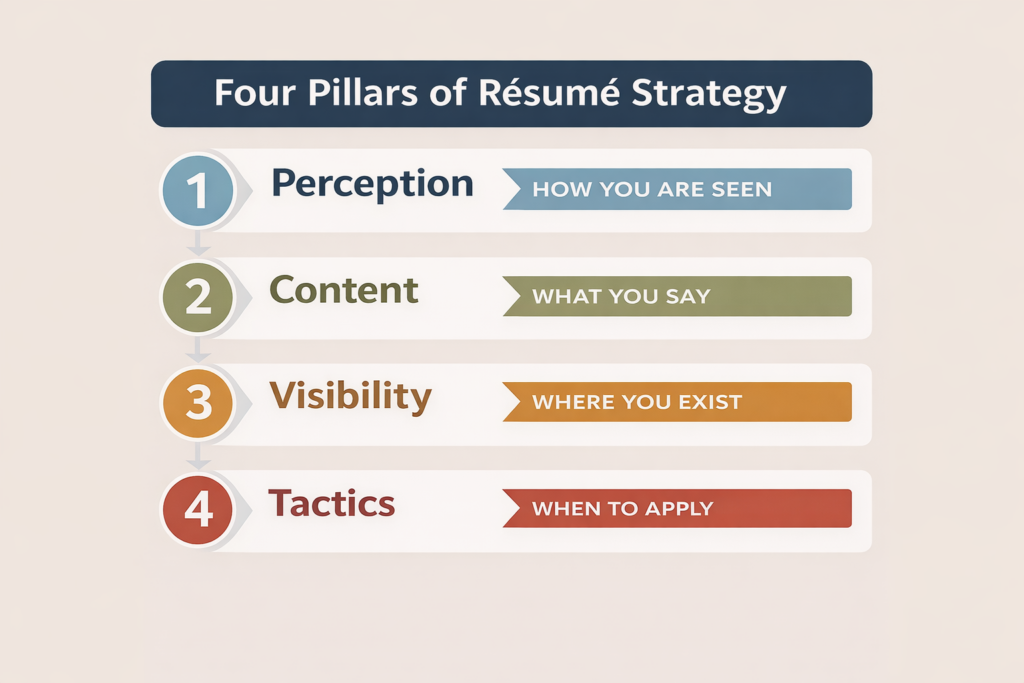
A strong resume and a clean digital footprint are necessary. They are not sufficient.
Every year, I see capable professionals fail to get invited for interviews—not because they lack skills or experience, but because their application tactics give decision‑makers reasons to screen them out early. They apply too fast, too eagerly, too broadly, through the wrong channels, or with signals that contradict the role they are targeting.
The practical question is this:
How do you engage in the market without giving decision-makers reasons to screen you out?
This article builds on the earlier discussion about resumes and digital footprint. Here, the focus shifts to application logistics: how you behave once you step into the market.
Your Disposition
Your focus must shift fully to the company and the role. Move from an ego‑centric attitude to a customer‑centric one.
You must distance yourself from your personal motivation to apply. Whether you are unemployed and feeling pressure, or employed and exploring options, is irrelevant to the hiring decision. Try not to bring it into the process. Hiring decisions are made to solve company problems, not candidate situations.
There is a natural temptation for candidates to treat hiring as a competition: How do I stand out? How do I beat others? This win‑lose framing is misleading and unproductive.
Hiring is a filtering process on both sides. If the role is not what you expected, if your skills are not a good match, or if the culture does not work for you, step away early. It is better to disengage early than to be unhappy or underperform later.
Even if you are not actively looking and are approached by a headhunter or through your network, the company and the role will quickly take center stage. The question becomes how your tools, experience, and personality can help address the organization’s needs.
There is no reason to become overconfident if you are contacted.
Universal Scenarios
Two scenarios apply universally:
• Applying for a current vacancy
• Applying for a future vacancy
Applying for a current vacancy (targeted application)
Only apply when your background matches the requirements in profession, sector, and enabling skills such as language, systems, location, and availability.
Adapt the keywords and summary of your general resume to the job requirements and the company’s business. In the first instance, it’s about the hiring organization; they hold the decision-making power. Your task is to show how you can help solve their problems. This assumes that your resume already presents a coherent and credible self‑portrait.
Again: do not lie.
Applying for a future vacancy (open application)
Only apply to companies you have researched and that genuinely fit your background.
Ideally, you apply through a network contact with a real connection to the company and a willingness to act as an advocate. Network contacts do not get you the job; their role is to open the door to an interview.
Sending your resume via a company website or general email address is usually ineffective. It’s like a hunter shooting randomly in the air because he is in the forest – he won’t hit anything.
Applying without a clear target is rarely productive.
Jobs to Apply For
These are tactical but crucial decisions. Please remember not to go in panic mode – especially when you are out of a job – and start shooting in all directions.
Below are clear guidelines on how to proceed.
Targeted applications require alignment of profession, sector, tools, and enabling skills. Be honest with yourself about fit. If your background matches less than 80% of these essential requirements, do not waste time or energy and move to the next opportunity.
How do you find jobs relevant to you? The simple answer is the Internet: use Boolean search strings relevant to your target jobs. Google and Bing are the most Boolean-friendly search engines. If you are not familiar with Boolean coding, ask your friendly AI to do it for you.
Open applications only work when they are researched and preferably supported by advocacy—not by mass forwarding.
In this bucket often fall applications sent to recruitment agencies. The same guideline applies here as well; do your homework about the recruiter that you are targeting: sector and level specialties, establish a connection before dumping your general resume in their inbox. You can connect either via LinkedIn, in person at networking events, or through your network friends.
Special cases
Changing professions will always be difficult unless you can demonstrate in your resume that you have developed relevant tools for the new profession outside your main career track.
Changing sectors is possible only when transferable skills are strong and sector‑specific know‑how requirements are low.
Applying well below or above your qualification level carries significant risk for both the company and candidate, and typically will get you screened out early on.
Just-in-time Logistics
Applications for hiring companies often peak during weekends, creating an overload on Mondays. Aim for your application to arrive mid‑week.
Job postings typically remain online for about a month. Companies often review applications after week one and week two. Later applications are monitored rather than actively reviewed. Applying within the first two weeks materially improves visibility.
Patience and ghosting
Silence is usually structural, not personal. When candidates apply for roles that clearly do not match their skills, companies may ignore their applications, sending a signal of poor judgment. Limit follow‑up attempts to 1.
Companies generally want to interact with candidates and build relationships for current or future needs. Ghosting candidates should be avoided, and tools—including AI—can help manage communication more responsibly.
Cover letter or not?
All applications sent by email deserve a cover letter. Do not repeat your resume. Reference the job posting and show that you have researched the company.
For open applications, explain why the company interests you and how your background could contribute.
Your Job Search is a Business Project
Approach your job search as a structured project without a fixed deadline.
Clarify your objectives.
Document your professional history in detail.
Translate achievements into stories: numbers plus context.
Put metrics in place: networking interactions, companies researched, targeted applications, and open applications.
Closing
The goal of applying is not to get hired. The goal is to earn a conversation.
When your resume, digital footprint, professional attitude, and application tactics are aligned, you reduce uncertainty at every screening step. Disciplined decisions about what you apply for, how you apply, and when you apply limit the reasons for decision‑makers to screen you out—and increase the chances that the process moves forward constructively for both sides.
******************
.
Related articles in this series
• Don’t Lie: Your Resume Is a Self-Portrait – reframes the resume as a credibility and risk signal
• Your Digital Footprint – shows how inconsistent online visibility can undermine even a strong resume.
• The Essential Components of a Solid Resume – focuses on structure, evidence, and consistency.